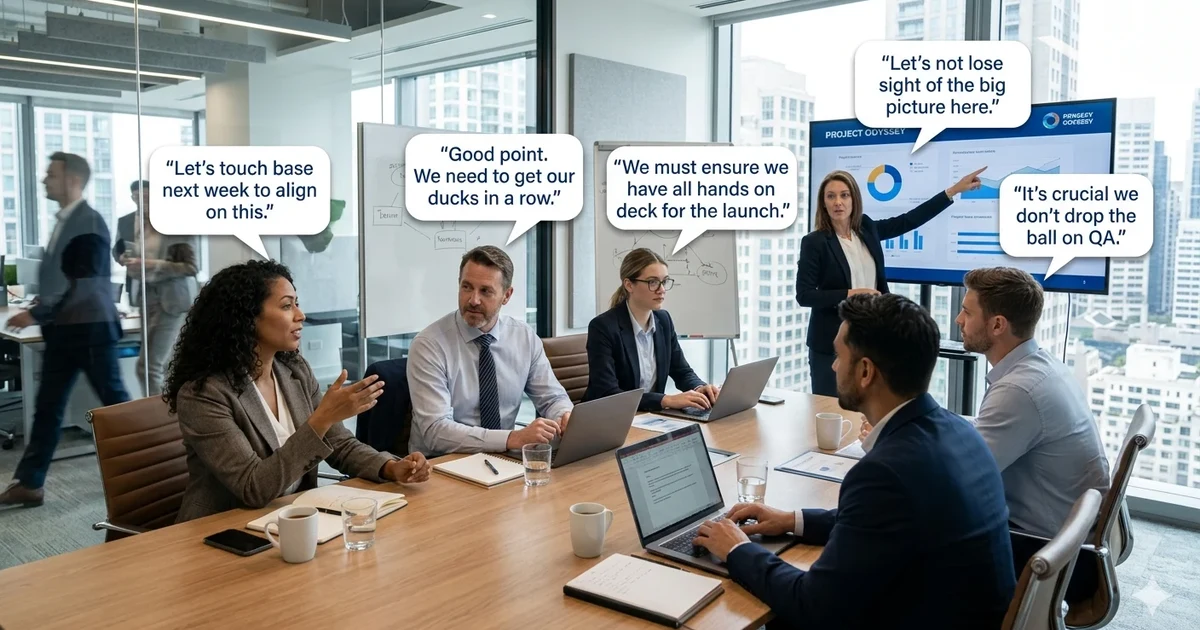
Quick Answer: Idioms for Business
Business idioms are short phrases used in the workplace that have meanings different from the actual words. They help people communicate ideas quickly and naturally in meetings, emails, and daily conversations.
Introduction
Business communication is not always about formal words and long emails. People often use short phrases that carry deeper meanings. These phrases are called idioms. In the workplace, idioms help people sound more natural and confident. They also make conversations quicker and more engaging.
You will hear business idioms in meetings, emails, and casual chats with colleagues. Managers use them while giving feedback. Teams use them while discussing ideas. If you understand these expressions, you can follow conversations easily and respond in a more natural way. It also helps you connect better with coworkers and clients.
Learning business idioms is not difficult. You just need to understand their meaning and see how people use them in real situations. Over time, they become a natural part of your communication style.
Meaning and Definition of Business Idioms
Business idioms are phrases that have a meaning different from the literal words. You cannot understand them by translating each word. Instead, you need to learn what the whole phrase means in a business context. These idioms are widely used in professional environments like offices, meetings, and emails.
For example, when someone says “get the ball rolling,” they do not mean an actual ball. They mean to start a task or project. This is why understanding context is very important. Without it, idioms can feel confusing, especially for beginners.
Business idioms make communication faster and more expressive. Instead of long explanations, a simple phrase can deliver the message clearly. They also show that you are comfortable with workplace language. Once you learn them, you will notice how often they appear in daily business communication.
Common Idioms for Business and Workplace Communication
Break the ice
Meaning: To start a conversation in a friendly way
Uses: People use it at the beginning of meetings or introductions
Example: The manager told a joke to break the ice
Think outside the box
Meaning: To think creatively
Uses: Used when new ideas are needed
Example: We need to think outside the box for this campaign
Get the ball rolling
Meaning: To start something
Uses: Used when beginning a project or discussion
Example: Let’s get the ball rolling on the new plan
Cut corners
Meaning: To do something cheaply or quickly
Uses: Used when quality is reduced to save time or money
Example: The company cut corners to finish early
On the same page
Meaning: To agree or understand clearly
Uses: Used in teamwork and discussions
Example: We need to be on the same page before moving forward
Back to the drawing board
Meaning: To start again
Uses: Used after a failed plan
Example: The idea failed so we went back to the drawing board
Hit the ground running
Meaning: To start quickly and actively
Uses: Used for new jobs or projects
Example: She hit the ground running on her first day
Learn the ropes
Meaning: To understand how something works
Uses: Used for new employees or tasks
Example: It took him a week to learn the ropes
In the red
Meaning: Losing money
Uses: Used in financial discussions
Example: The company was in the red last year
In the black
Meaning: Making profit
Uses: Used in financial success context
Example: Now the business is back in the black
Ahead of the curve
Meaning: More advanced than others
Uses: Used for innovation or trends
Example: Our company stays ahead of the curve
Touch base
Meaning: To make quick contact
Uses: Used for short meetings or updates
Example: Let’s touch base tomorrow
Raise the bar
Meaning: To set higher standards
Uses: Used in performance discussions
Example: The new policy raised the bar
Close the deal
Meaning: To finalize an agreement
Uses: Used in sales or negotiations
Example: He finally closed the deal
Go the extra mile
Meaning: To put in extra effort
Uses: Used to show dedication
Example: She always goes the extra mile
Keep someone in the loop
Meaning: To keep someone informed
Uses: Used in team communication
Example: Please keep me in the loop
Run a tight ship
Meaning: To manage strictly and efficiently
Uses: Used for leadership style
Example: The manager runs a tight ship
Time is money
Meaning: Time is valuable
Uses: Used to emphasize productivity
Example: Let’s move fast because time is money
Bottom line
Meaning: The final result or main point
Uses: Used in decisions and summaries
Example: The bottom line is profit matters
Win-win situation
Meaning: A situation where everyone benefits
Uses: Used in negotiations
Example: The deal was a win-win situation
Practical Usage of Business Idioms in Workplace Communication
Business idioms become useful when you start using them in real conversations. You do not need to use them all at once. Start with simple ones and use them where they fit naturally. Over time, they will become part of your daily communication.
You will notice that idioms make your speech sound more confident. They also help you explain ideas quickly without long sentences. Just make sure you understand the context before using them.
Real-life examples:
- Let’s get the ball rolling on the new marketing plan
- We need to stay on the same page during this project
- The company is finally back in the black
- Can we touch base later about the report
- She always goes the extra mile for clients
- This strategy puts us ahead of the curve
Business Idioms Comparison Table for Formal vs Informal Use
| Aspect | Hard Work Approach | Smart Work Approach |
|---|---|---|
| Focus | Long hours | Efficient methods |
| Effort | High physical effort | Strategic thinking |
| Time Use | Time consuming | Time saving |
| Results | Slow progress | Faster outcomes |
| Decision Style | Routine based | Idea driven |
| Flexibility | Less flexible | More adaptable |
How to Use Business Idioms Effectively in Communication
Start by using simple idioms in daily conversations
- Understand the meaning before using
- Use them in the right context
- Keep your audience in mind
- Avoid overusing in formal writing
- Practice in meetings and emails
Common Mistakes When Using Business Idioms
Many people make small errors when using idioms
- Using idioms without understanding meaning
- Mixing up similar idioms
- Overusing them in one conversation
- Using them in very formal situations
- Ignoring cultural differences
Conclusion
Business idioms may seem confusing at first, but they become easier with practice. Once you understand their meanings, you will start noticing them everywhere. They help you communicate ideas quickly and sound more natural in professional settings.
You do not need to learn everything at once. Start small and use a few idioms in your daily conversations. With time, your confidence will grow. The goal is not perfection but clear and natural communication.
FAQs About Business Idioms and Workplace Communication
What are business idioms?
They are phrases used in business that have special meanings.
Why are idioms important in business?
They make communication faster and more natural.
Can beginners use business idioms?
Yes, start with simple ones and practice regularly.
Are idioms used in formal emails?
Use them carefully and only when appropriate.
How can I learn business idioms fast?
Read, listen, and practice in real conversations.
Do native speakers use idioms daily?
Yes, they use them often in casual and professional talk.
Can idioms improve communication skills?
Yes, they make you sound more fluent and confident.
What is the difference between idioms and slang?
Idioms are widely accepted while slang is more casual.
Should I use idioms in presentations?
Use a few to keep it natural, but do not overuse.
Are business idioms the same worldwide?
Many are common, but some vary by region.