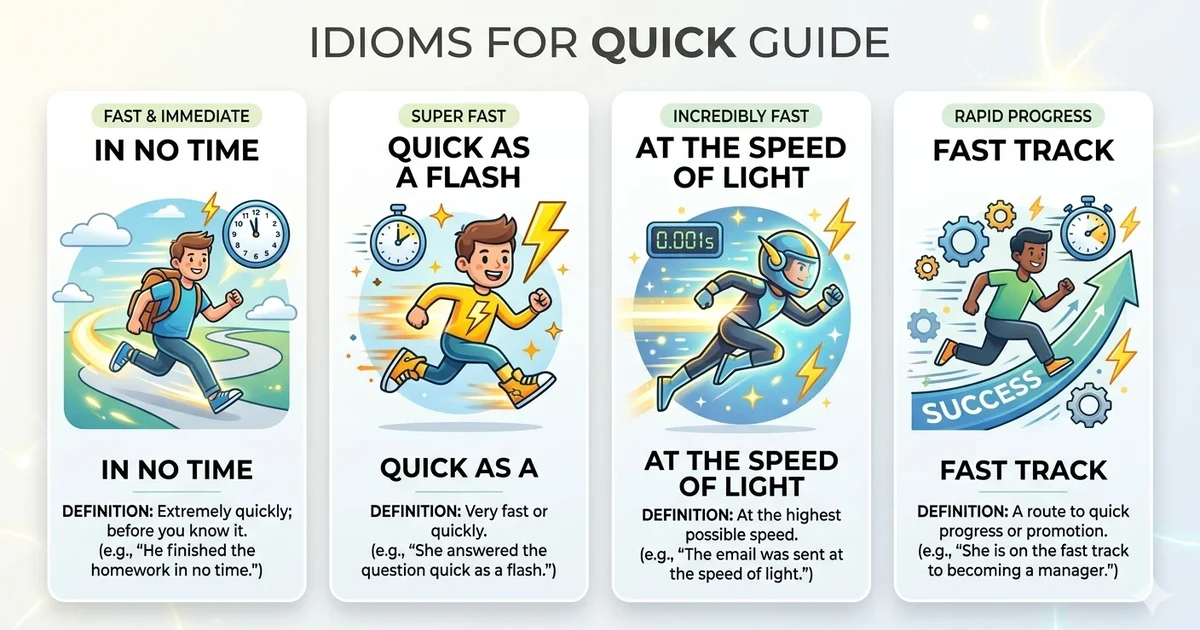
Quick Answer Box
Idioms for Quick are phrases used to describe actions that happen very fast or without delay.
They do not mean words literally but show speed in a natural and expressive way in English.
Introduction
Idioms for quick help you express speed in a natural and colorful way. These phrases make English more lively and expressive. People use them when they want to show that something happens very fast or without delay. Instead of saying “very fast” every time, idioms give a better way to speak.
In daily English, idioms for quick appear in conversations, stories, movies and even workplace talk. They make language feel more natural and less boring. When you learn these idioms, you understand native speakers better and you also sound more fluent.
These expressions do not usually mean the words directly. For example, “in a flash” does not mean a real flash. It simply means something happens very quickly. That is why idioms feel interesting and sometimes confusing for learners.
Idioms for Quick Meaning and Definition Explained Simply
Idioms for quick are phrases that describe actions happening at high speed or without delay. They do not follow literal meanings of words. Instead, they give a fixed expression that native speakers understand as “very fast”.
People use these idioms in speaking and writing when they want to show urgency, speed or instant action. These phrases help add emotion and clarity to communication. They also make sentences sound more natural and less direct.
In simple words, idioms for quick replace basic words like fast or quickly with more creative expressions. This makes English richer and more engaging in real situations.
Common Idioms for Quick in English Language
These idioms appear often in daily communication. They describe speed, instant action and quick responses in different ways.
Practical Usage of Idioms for Quick in Daily Communication
Idioms for quick make speech more natural and expressive. People use them in casual talks, storytelling and even work discussions. They help show urgency or speed without repeating the same words again and again.
You can hear them in real life when someone talks about finishing work, reacting fast or moving quickly. They also appear in movies and everyday conversations between friends and colleagues.
Examples:
He finished his homework in a jiffy and went outside to play.
She replied to the message in no time.
The bus arrived in a flash during the morning rush.
He solved the problem like a shot when the teacher asked.
They reached the station in double quick time to catch the train.
The team completed the project in record time.
Comparison Table: Idioms for Quick vs Similar Expressions
| Expression Type | Example | Usage | Impact |
|---|---|---|---|
| Hard Work | Work step by step | Slow but steady progress | Focus on effort |
| Smart Work | Work smartly | Faster results with planning | Focus on efficiency |
Idioms for Quick: 20 Common Quick Related Idioms
In a flash
Meaning: Something that happens very quickly
Uses: Used when an action takes almost no time
Example: The lights went off in a flash during the storm
In no time
Meaning: Very quickly without delay
Uses: Used for actions completed fast
Example: She cleaned the room in no time
In a jiffy
Meaning: Extremely short time
Uses: Common in casual conversations
Example: I will be back in a jiffy
At the drop of a hat
Meaning: Without any delay or hesitation
Uses: Used when someone acts immediately
Example: He helps his friends at the drop of a hat
Like a shot
Meaning: Very quickly and without thinking
Uses: Used for fast reaction
Example: She agreed like a shot when she heard the plan
In the blink of an eye
Meaning: Very fast moment
Uses: Used when something changes suddenly
Example: The weather changed in the blink of an eye
Faster than the wind
Meaning: Extremely fast movement
Uses: Used for dramatic speed description
Example: The cyclist passed the road faster than the wind
As quick as lightning
Meaning: Very fast action
Uses: Used for sudden quick movements
Example: He ran as quick as lightning to catch the bus
Quick as a wink
Meaning: Instant action
Uses: Used in storytelling or informal speech
Example: The child disappeared quick as a wink
In double quick time
Meaning: Faster than normal speed
Uses: Used when something finishes early
Example: They packed everything in double quick time
On the double
Meaning: Do something immediately
Uses: Used in commands or urgent requests
Example: The officer asked them to leave on the double
Before you know it
Meaning: Happens so fast you do not notice
Uses: Used for unexpected quick events
Example: The holiday ended before you know it
In record time
Meaning: Fastest possible time
Uses: Used for achievements or performance
Example: The team finished the task in record time
Like greased lightning
Meaning: Extremely fast movement
Uses: Used in informal speech for speed
Example: He drove like greased lightning on the highway
In a heartbeat
Meaning: Very quickly and emotionally fast decision
Uses: Used when someone agrees instantly
Example: I would help you in a heartbeat
Quick off the mark
Meaning: Reacting fast
Uses: Used for quick thinking or response
Example: She was quick off the mark in the quiz
Move at lightning speed
Meaning: Extremely fast movement
Uses: Used in action situations
Example: The rescue team moved at lightning speed
Fast as a whip
Meaning: Very quick reaction
Uses: Used in informal comparisons
Example: His reflexes are fast as a whip
In split seconds
Meaning: Very small unit of time
Uses: Used in high speed situations
Example: The accident happened in split seconds
Rapid fire pace
Meaning: Very fast continuous action
Uses: Used for quick repeated actions
Example: He asked questions at rapid fire pace
How to Use Idioms for Quick
Idioms for quick fit best in daily speaking and informal writing. They help you sound more natural and expressive in English.
Use them when you want to show speed, urgency or instant action in a simple way.
- Use idioms in casual conversation
- Match idiom with correct situation
- Practice with real daily examples
- Avoid literal meaning thinking
- Use them to make speech natural
Common Mistakes in Using Idioms for Quick
Many learners use idioms in the wrong way or in the wrong place. This can make sentences confusing.
- Using idioms in formal academic writing
- Mixing literal and idiomatic meaning
- Overusing too many idioms in one sentence
- Changing words inside fixed idioms
- Using idioms without understanding context
Conclusion
Idioms for quick make English more natural, expressive and interesting. They help you describe speed in a creative way instead of using simple words again and again. When you use them correctly, your communication feels more fluent and closer to native speech.
These idioms appear in daily life, stories and conversations. Learning them slowly and practicing in real sentences improves your confidence. Over time, you start using them without thinking. That is when your English sounds more natural and smooth.
FAQs About Idioms for Quick
What are idioms for quick in English?
They are phrases that show something happens very fast.
Why do we use idioms for quick?
They make English more natural and expressive.
Are idioms for quick used in daily speech?
Yes, native speakers use them very often.
What is the easiest idiom for quick?
“In no time” is one of the simplest.
Can I use idioms for quick in writing?
Yes, especially in informal writing.
What does “in a flash” mean?
It means something happens very quickly.
Are idioms for quick formal or informal?
Mostly informal.
How can I learn idioms for quick easily?
Practice them in real sentences daily.
What is the difference between fast and quick idioms?
Idioms are phrases, not single words.
Do idioms for quick have literal meaning?
No, they have fixed figurative meanings.