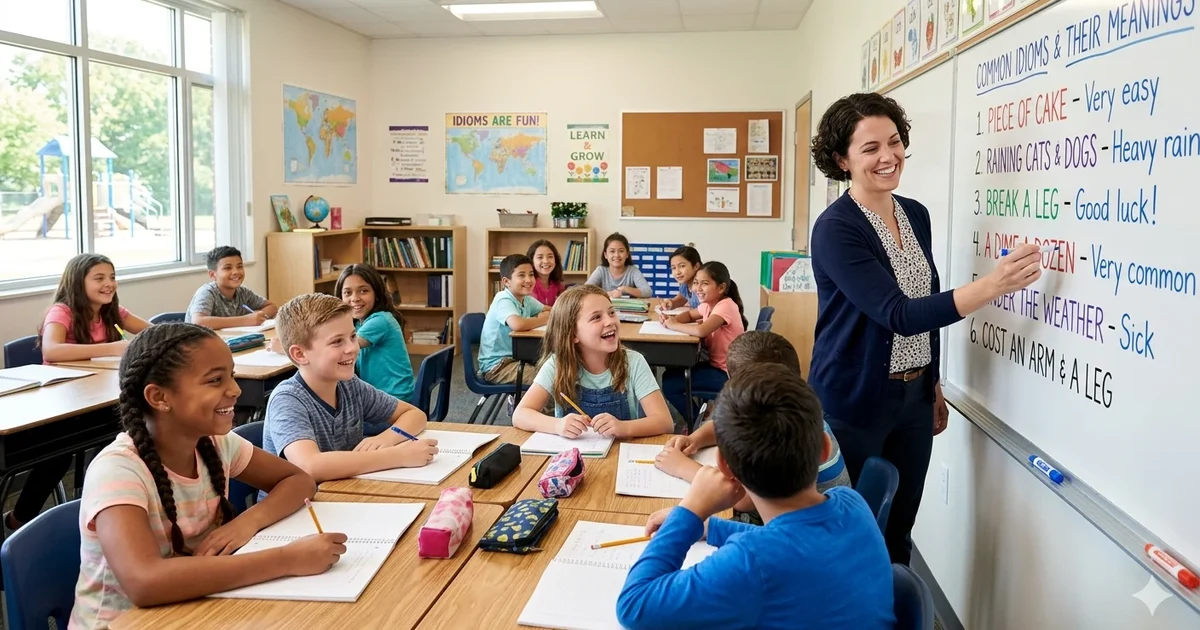
Teachers hear and use many expressions during daily classroom life. Some of these expressions are simple phrases that carry deeper meanings. These are called idioms. They do not mean exactly what the words say. Instead, they share an idea or message in a creative way. Teachers often use them when explaining lessons, motivating students, or talking about learning.
Idioms also make communication more interesting. A teacher may tell a student to “hit the books” before an exam or say someone “passed with flying colors.” These phrases sound fun, but they also help students understand ideas about studying, effort, and success. Because teachers use these phrases often, students slowly learn their meanings through real conversation.
Learning teacher related idioms also helps students improve English skills. Many idioms appear in books, conversations, and exams. When students understand them, they follow lessons more easily. Teachers also benefit because idioms make explanations clearer and more engaging. In simple terms, idioms bring language and learning together in a lively way.
Meaning and Definition of Idioms for Teachers
Idioms for teachers are common English expressions related to learning, teaching, studying, and classroom experiences. These phrases do not follow their literal meaning. Instead, they express ideas about education, effort, and understanding in a simple and memorable way.
Teachers often use idioms when giving advice or encouraging students. For example, a teacher might say “put on your thinking cap” before solving a problem. This does not mean wearing a real hat. It simply means thinking carefully. These expressions help teachers explain ideas quickly while keeping the mood light and friendly.
Idioms also reflect everyday classroom situations. They describe learning progress, student behavior, or the process of understanding something new. When students hear them often, they start recognizing patterns in language. Over time, they learn that idioms carry meaning beyond the words themselves. This makes communication richer and helps learners become more confident with English.
Common Idioms for Teachers
Teach an Old Dog New Tricks
Meaning: It is difficult to teach new skills to someone who is used to old habits.
Uses: Teachers use this when talking about people who find it hard to learn new methods. It often appears in discussions about change or learning later in life.
Example: My grandfather struggles with smartphones because you cannot easily teach an old dog new tricks.
School of Hard Knocks
Meaning: Learning from tough real life experiences.
Uses: Teachers use this phrase when someone gains knowledge through challenges instead of formal education.
Example: He never went to college but learned business in the school of hard knocks.
Pass with Flying Colors
Meaning: To succeed in something with excellent results.
Uses: Teachers say this when students perform very well in exams or projects.
Example: She studied hard and passed the final test with flying colors.
Learn the Ropes
Meaning: To understand how something works.
Uses: Teachers use it when students begin learning a new subject or activity.
Example: It took the new student a week to learn the ropes in the classroom.
Hit the Books
Meaning: To begin studying seriously.
Uses: Teachers say this when encouraging students to focus on study time.
Example: Exams start tomorrow so it is time to hit the books.
By the Book
Meaning: Doing something strictly according to rules.
Uses: Teachers use this phrase when explaining proper procedures or instructions.
Example: The teacher follows school policies by the book.
A Class Act
Meaning: Someone who behaves with respect and excellence.
Uses: Teachers use it to praise a student with great character and behavior.
Example: Helping classmates makes you a real class act.
Make the Grade
Meaning: To reach the required level of success.
Uses: Teachers say this when students achieve expected results in work or exams.
Example: He worked hard to make the grade in math.
Read Between the Lines
Meaning: To understand a hidden meaning.
Uses: Teachers use it when students analyze deeper messages in stories or lessons.
Example: Good readers know how to read between the lines.
Teacher’s Pet
Meaning: A student who receives special attention from the teacher.
Uses: Students often say this jokingly about classmates who teachers praise often.
Example: Some kids think he is the teacher’s pet because he answers every question.
Back to the Drawing Board
Meaning: To start again after failure.
Uses: Teachers say this when a plan or project needs improvement.
Example: Our science experiment failed so we must go back to the drawing board.
A Sharp Mind
Meaning: Someone who thinks quickly and clearly.
Uses: Teachers use it to describe intelligent students.
Example: Maria has a sharp mind for solving math problems.
Hit the Nail on the Head
Meaning: To describe something exactly correct.
Uses: Teachers say this when a student gives the perfect answer.
Example: Your explanation hit the nail on the head.
Put on Your Thinking Cap
Meaning: To start thinking carefully.
Uses: Teachers use this phrase before difficult questions or activities.
Example: Put on your thinking cap before solving this puzzle.
A Quick Study
Meaning: Someone who learns very fast.
Uses: Teachers use it to praise students who understand lessons quickly.
Example: The new student is a quick study in science.
Old School
Meaning: Traditional or classic methods.
Uses: Teachers use it when describing older teaching styles.
Example: My teacher prefers old school teaching methods.
Above and Beyond
Meaning: Doing more than expected.
Uses: Teachers say this when students show extra effort.
Example: Her project went above and beyond the assignment.
A Learning Curve
Meaning: The time it takes to understand something new.
Uses: Teachers explain this when students struggle at the beginning of learning.
Example: Coding has a learning curve but practice helps.
Word of Mouth
Meaning: Information shared through people talking.
Uses: Teachers use it when news spreads among students quickly.
Example: The event became popular through word of mouth.
On the Same Page
Meaning: To understand something in the same way.
Uses: Teachers say this when students share the same understanding.
Example: Let us review the lesson so everyone stays on the same page.
Practical Usage of Idioms for Teachers in Classroom Communication
Teachers often use idioms while speaking naturally in the classroom. These phrases appear during lessons, discussions, and casual conversation. They help explain ideas quickly and make communication feel more friendly.
Students also learn language naturally when teachers use idioms. Hearing them in real situations helps students understand meaning without memorizing definitions. Over time, these expressions become part of everyday classroom language.
Real life examples:
The teacher told the class to hit the books before the final exam.
When the group project failed, the teacher said it was time to go back to the drawing board.
After hearing a perfect answer, the teacher said the student hit the nail on the head.
The new student learned classroom rules quickly and proved to be a quick study.
During reading class, the teacher asked students to read between the lines of the story.
Idioms for Teachers vs Idioms for Students Comparison Table
| Aspect | Teacher Related Idioms | Student Related Idioms |
|---|---|---|
| Focus | Teaching methods and guidance | Learning effort and progress |
| Example | Put on your thinking cap | Hit the books |
| Purpose | Encourage thinking and understanding | Encourage studying and practice |
| Usage | Often spoken by teachers | Often used by students |
| Tone | Instructional and motivational | Effort and achievement focused |
How to Use Idioms for Teachers in Teaching
Teachers can include idioms naturally while explaining lessons.
• Use idioms while giving study advice
• Explain meanings with simple examples
• Encourage students to use idioms in sentences
• Use them during storytelling or reading lessons
• Repeat them naturally in classroom conversation
Common Mistakes with Teacher Idioms
Many learners misunderstand idioms because they take the words literally.
• Thinking idioms have literal meanings
• Using idioms in very formal writing
• Misusing idioms in the wrong situation
• Forgetting the context of the phrase
• Overusing idioms in every sentence
FAQs About Idioms for Teachers
What are idioms for teachers?
They are expressions related to teaching and learning situations.
Why do teachers use idioms in class?
They make explanations more interesting and memorable.
Are idioms important for students?
Yes. They help students understand natural English.
Can idioms appear in exams?
Yes. Many language exams include idioms.
How can students learn idioms faster?
By reading, listening, and practicing them in sentences.
Are idioms formal or informal?
Most idioms are informal and used in everyday speech.
Do idioms have literal meanings?
No. Their meanings are usually figurative.
Can teachers teach idioms through stories?
Yes. Stories help students understand context.
Why are idioms hard for beginners?
Because the meaning is different from the words.
How many idioms should students learn at once?
A few at a time works best for understanding.
Conclusion
Idioms for teachers bring life and personality to classroom language. They help teachers explain ideas in a fun and memorable way. Instead of long explanations, a simple phrase like “hit the books” or “put on your thinking cap” can communicate the message clearly. These expressions also make lessons more engaging and easier to remember.
For students, learning these idioms improves both vocabulary and communication skills. When students hear them often, they start recognizing patterns and meanings naturally. Over time, they become comfortable using them in conversations and writing. Understanding idioms not only strengthens language ability but also makes everyday English feel more natural and enjoyable.