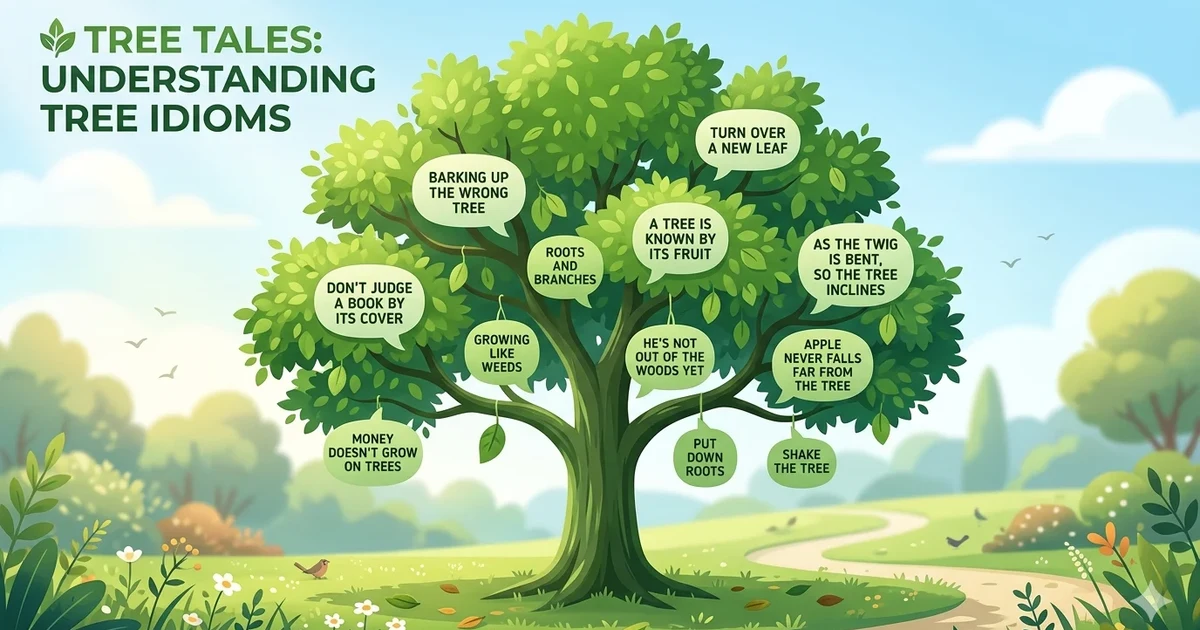
Language often borrows images from nature. Trees appear often in English idioms because they feel familiar and easy to picture. People see trees every day. Their branches, roots, and leaves make strong visual symbols. Because of this, many expressions use trees to explain ideas, mistakes, or life situations.
Idioms for trees help speakers describe complex feelings in a simple way. When someone says a person is barking up the wrong tree, they do not mean an actual tree. They mean the person made a wrong guess or blamed the wrong person. The image of a dog barking at the wrong tree makes the idea easy to understand.
Learning tree idioms also helps English learners sound more natural. These phrases appear in daily conversation, movies, books, and even business discussions. Once you understand them, you start noticing them everywhere. They add color to speech and make communication more lively.
Meaning and Definition of Tree Idioms
Tree idioms are figurative expressions that use trees or parts of trees to describe ideas, actions, or situations. The meaning does not come from the literal words. Instead, the expression carries a symbolic message that people understand through common usage.
English uses many natural images to explain life experiences. Trees represent growth, stability, family roots, and decision making. For example, the phrase turn over a new leaf suggests starting fresh, just like a tree grows new leaves in a new season.
These idioms also show how humans connect language with nature. A tree can symbolize strength, confusion, growth, or mistakes depending on the context. Because these images feel simple and visual, speakers remember them easily.
Understanding tree idioms helps learners improve both vocabulary and cultural awareness. Instead of translating words one by one, learners start understanding the meaning behind the expression. That skill makes conversations smoother and more natural.
Why Idioms for Trees Are Common in English Language
Trees have always been part of human life. People used them for shelter, food, and tools long before modern cities existed. Because of this deep connection, many cultures built stories and expressions around trees.
In English, trees represent ideas like growth, family roots, mistakes, and perspective. A forest can symbolize confusion. A strong oak can symbolize strength. A falling leaf can represent change. These natural images make abstract ideas easier to explain.
Another reason these idioms remain popular comes from storytelling. Writers and speakers often prefer vivid language instead of plain descriptions. Tree idioms create quick mental pictures, which makes conversations more memorable.
Common Idioms for Trees List
Barking Up the Wrong Tree
Meaning: Accusing the wrong person or following the wrong idea.
Uses: People say this when someone blames the wrong person or searches for answers in the wrong place. It often appears in casual conversations or debates.
Example: If you think I broke the laptop, you are barking up the wrong tree.
Money Doesn’t Grow on Trees
Meaning: Money is limited and must be earned.
Uses: Parents often say this when teaching children about spending carefully. It reminds people that money does not appear easily.
Example: My dad always says money doesn’t grow on trees when I ask for new gadgets.
Out on a Limb
Meaning: Taking a risk or holding an unpopular opinion.
Uses: This idiom appears when someone supports an idea without strong support from others. It can describe brave or risky decisions.
Example: I may be out on a limb, but I think the smaller company will win.
Turn Over a New Leaf
Meaning: Start behaving in a better or different way.
Uses: People use it when someone decides to improve habits or change their lifestyle.
Example: After failing the exam, he promised to turn over a new leaf.
Wood for the Trees
Meaning: Being unable to see the bigger picture because of small details.
Uses: This idiom appears in discussions when someone becomes too focused on minor issues.
Example: The team could not see the wood for the trees during the long meeting.
Beat Around the Bush
Meaning: Avoid speaking directly about a topic.
Uses: Speakers use it when someone talks indirectly instead of giving a clear answer.
Example: Stop beating around the bush and tell me what happened.
Up a Tree
Meaning: In a difficult or confusing situation.
Uses: It describes moments when someone feels stuck or unable to solve a problem.
Example: I was really up a tree when my computer crashed before the deadline.
Shake Like a Leaf
Meaning: Tremble with fear or nervousness.
Uses: People say this when someone feels very anxious before an event.
Example: I shook like a leaf before my first job interview.
Mighty Oaks from Little Acorns Grow
Meaning: Great achievements often start from small beginnings.
Uses: Teachers and mentors often use it to encourage patience and long term effort.
Example: Her small online shop grew quickly because mighty oaks from little acorns grow.
The Apple Doesn’t Fall Far from the Tree
Meaning: Children often behave like their parents.
Uses: This idiom appears when family members share similar habits or personalities.
Example: He loves music just like his mother. The apple doesn’t fall far from the tree.
As Straight as a Pine
Meaning: Honest or morally upright.
Uses: People use it to describe someone who behaves in a very honest and direct way.
Example: Everyone trusts him because he is as straight as a pine.
Branch Out
Meaning: Try new activities or explore different opportunities.
Uses: Businesses and individuals use this expression when expanding into new areas.
Example: She started as a baker but later branched out into catering.
Nip Something in the Bud
Meaning: Stop a problem before it grows bigger.
Uses: Leaders often use this idiom when dealing with small issues early.
Example: The manager decided to nip the conflict in the bud.
Rooted to the Spot
Meaning: Unable to move because of shock or surprise.
Uses: People say this when someone freezes during a surprising moment.
Example: I stood rooted to the spot when I heard the loud crash.
Tall as a Tree
Meaning: Very tall or physically impressive.
Uses: It describes people who stand much taller than others.
Example: My younger brother is now tall as a tree.
Climb the Wrong Tree
Meaning: Choose the wrong solution or blame the wrong person.
Uses: Similar to barking up the wrong tree, this idiom highlights a mistaken direction.
Example: If you think she lost the file, you climbed the wrong tree.
Green as a Tree
Meaning: Very inexperienced or new at something.
Uses: It describes beginners who still need to learn skills or knowledge.
Example: I was green as a tree when I started my first job.
A Tree Is Known by Its Fruit
Meaning: People are judged by their actions and results.
Uses: This idiom appears in moral discussions and advice.
Example: A good leader proves it through actions because a tree is known by its fruit.
Can’t See the Forest for the Trees
Meaning: Focusing on details so much that the big picture becomes unclear.
Uses: Often used in work or planning discussions.
Example: The team could not see the forest for the trees during the project review.
Deep Rooted
Meaning: Strongly established and difficult to change.
Uses: It describes beliefs or traditions that exist for a long time.
Example: Respect for elders remains deep rooted in many cultures.
Tree Idioms Meaning and When to Use Them
Tree idioms usually appear in informal conversations, storytelling, and everyday advice. People use them to describe mistakes, growth, personality traits, and life lessons. Because the images come from nature, the expressions feel easy to understand.
You often hear them in workplaces, classrooms, and casual talks with friends. For example, someone may say a colleague is barking up the wrong tree during a discussion. Another person may say they want to turn over a new leaf after making a mistake.
These idioms help speakers express emotions or opinions quickly. Instead of long explanations, a simple phrase delivers the message clearly.
Idioms for Trees vs Nature Idioms
Nature idioms include expressions related to weather, animals, plants, and landscapes. Tree idioms belong to this larger group but focus only on trees and their parts.
Tree idioms usually describe growth, direction, mistakes, and family relationships. Other nature idioms may describe emotions, speed, or personality traits using animals or weather images.
Practical Usage of Tree Idioms in Daily English
People often use tree idioms during relaxed conversations. They appear when giving advice, describing mistakes, or explaining situations. Because these expressions feel visual, listeners usually understand the message quickly.
You may hear them at work, in classrooms, or during family discussions. They help speakers sound more natural and expressive without using complicated explanations.
Real life examples:
- My manager said I was barking up the wrong tree about the project delay.
- After last year’s mistakes, she decided to turn over a new leaf.
- During the meeting, the team could not see the forest for the trees.
- The young employee looked green as a tree on his first day.
- The coach reminded us that mighty oaks from little acorns grow.
Comparison Table: Tree Idioms vs Plant Idioms
| Feature | Tree Idioms | Plant Idioms |
|---|---|---|
| Main Image | Trees and branches | Flowers, seeds, and plants |
| Common Meaning | Growth, mistakes, perspective | Beauty, growth, emotions |
| Example | Barking up the wrong tree | Nip it in the bud |
| Usage Style | Advice and decision making | Personal feelings or change |
| Tone | Practical and descriptive | Often emotional or poetic |
How to Use Idioms for Trees Correctly
Use tree idioms naturally in conversation.
- Use them in casual speaking and storytelling
- Match the idiom with the right situation
- Keep the wording exactly the same
- Listen to how native speakers use them
- Practice them in sentences while speaking English
Common Mistakes When Using Tree Idioms
Learners often make small errors when using idioms.
- Taking the idiom literally instead of figuratively
- Changing the wording of fixed expressions
- Using them in very formal writing
- Mixing two idioms together incorrectly
- Using an idiom in the wrong context
Conclusion
Idioms for trees add life and color to the English language. They turn simple natural images into powerful expressions that explain mistakes, growth, and everyday experiences. Because trees feel familiar to everyone, these idioms create clear mental pictures that people remember easily.
Learning them also helps English learners sound more natural. Instead of long explanations, a short idiom can deliver the message clearly.
When you understand the meaning and context, these expressions become easy to use in daily conversations. Over time, they become part of your natural vocabulary and make your communication more engaging.
FAQs About Idioms for Trees
What are idioms for trees in English
Tree idioms are figurative phrases that use trees to express ideas or situations.
Why are tree idioms common in English
Trees provide simple visual images that help explain complex ideas easily.
What is the most common tree idiom
Barking up the wrong tree remains one of the most popular tree idioms.
Are tree idioms used in everyday conversation
Yes. People use them often in casual conversations and storytelling.
How can learners remember tree idioms easily
Learning them through examples and real conversations helps memory.
Do tree idioms appear in books and movies
Yes. Writers use them to make dialogue feel natural and expressive.
Can tree idioms improve English fluency
Yes. Using idioms makes speech sound more natural and confident.
Are tree idioms suitable for formal writing
Most idioms fit better in casual or creative writing.
What does turn over a new leaf mean
It means starting fresh and improving behavior.
What does money doesn’t grow on trees teach
It reminds people to spend money carefully and value hard work.